
   | |
| Polar and Grizzly Hybrid |
Scientists argue that hybrids do not support climate change because these hybrids have happened in the past; A few instances aren't enough. But these "rare" instances are occurring more and more frequently now--and it's not like polar bears and grizzly bears have always been friendly together. The interactions are usually aggressive. It is not uncommon for bears to encounter each other in the wild and to view each other as prey, even within the same species.
Additionally, while the two species are genetically similar and often found in the same territories, they tend to avoid each other in the wild. They also fill different ecological niches. Grizzlies tend to live and breed on land. Polar bears prefer the water and ice, usually breeding on the ice.
Multiple bear species have been crossbred in zoos. Scientists just never expected a polar bear and grizzly to mate in the wild. Zoo animals are caged together- wild bears roam free. It is an unusual for mating to occur in the wild because both species require an extended mating ritual to reproduce. Females ovulate only after spending several days with a male and then mate several times over several days to ensure fertilization. How long can two conflicting species tolerate each other, even during the season of love?
Chance encounters could happen periodically. But since the offspring are weird looking and probably outcasts, they may have low reproductive success and thereby fail to pass their genes on to the next generation. Polar bears would most likely prefer to mate with other polar bears, and grizzlies with other grizzlies, rather than with an odd-looking hybrid. And looking at "pure DNA" neither species have had much interbreeding. But fairly recently, in 2010, an Inuvialuit hunter from Ulukhaktok on Victoria Island shot what he thought was a polar bear. After inspecting the bear and having DNA testing done, it was found that the bear's mother was a grizzly-polar hybrid and the father was a grizzly bear. It may be the first recorded second-generation polar-grizzly bear hybrid found in the wild.
So why is this happening? Well, climate change may also play a role, causing an increasing overlap in range and mating season and territory. The warming Arctic environment is causing some animals to shift their range northward. Hunting policy itself may play a role, reducing the number of males and driving the females to mate with the next best available male-- a male grizzly bear.
This hybridization and climate change is all a natural part of life. The world is always changing--sometimes faster, sometimes slower. Dinosaurs go extinct, mammals take over. The climate warms up, insects take over. Polar bears go extinct, grolar bears take its place.
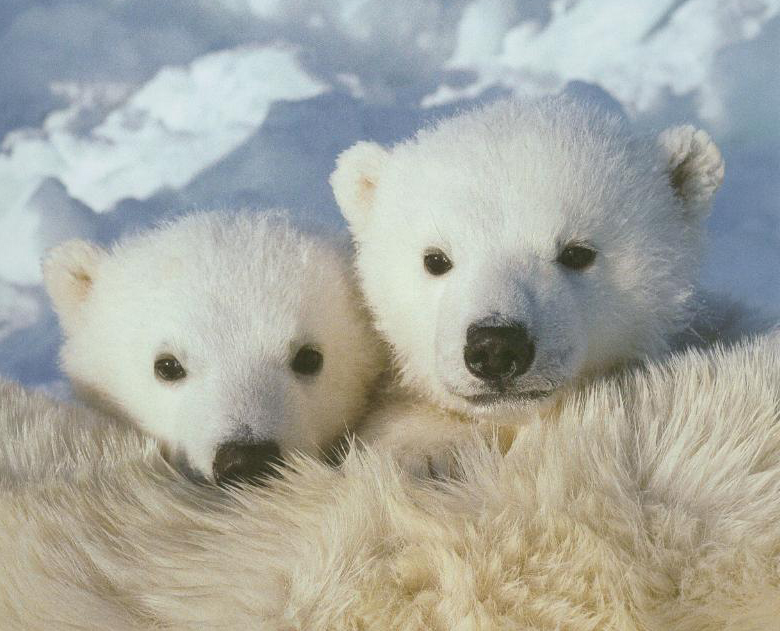 |
| Say bye-bye to these babies. |
As for behavior and temperament, the hybrids demonstrated behavior more similar to polar bears than grizzlies. They stamped toys similar to how polar bears break ice, and hurled bags to the side as polar bears may hurl prey. Grizzlies given the same bags do not demonstrate this hurling behavior. The hybrids were also observed lying down similar to polar bears: on their stomachs with rear legs splayed.
What this could mean is we get a bear bigger than a grizzly bear, that can tolerate both a warmer climate and a cooler one. While the grolar bear has the behavior and temperament like of a polar bear, the hybrids are more likely to breed with grizzlies, bears known for being the most aggressive of all. Grizzly bears are omnivores, and polar bears ares are omnivore, but grolar bears are likely to be omnivores because of their available food on land. But what we could get is one fierce bear to contend with.
 |
| They could be as scary as these guys. |

No comments:
Post a Comment